Kīlauea in Concert
We’ve turned visual patterns in NASA’s imagery of aerosols, tiny particles and droplets floating in the air, into music so you can see, hear, and feel atmospheric change.
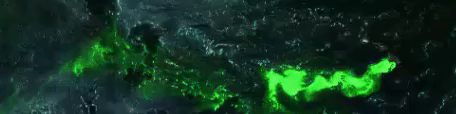
We composed this music from patterns in NASA’s 2024 Kīlauea aerosol imagery.
15°–25°N | 170°E–150°W
NASA SVS 5552As a team from Hawaiʻi, we were drawn to NASA’s visualization of a volcanic sulfate plume, a stream of tiny airborne particles, from Kīlauea, an active volcano on the Big Island of Hawaiʻi. The plume moves west with the trade winds, which generally blow from east to west around Hawaiʻi. This cropped view shows aerosol patterns estimated by NASA’s computer models. Green represents sulfate aerosols. Cyan (blue-green) represents sea salt aerosols. We identify visual patterns, including swirls and plumes, and turn them into the individual notes, chords, and sounds you hear.
Imagery: NASA GMAO / Scientific Visualization Studio.
Music: Created by our team, using samples from VSCO 2 CE and Epic Choir / VocalSet samples.
What am I seeing?
Volcanoes such as Kīlauea release sulfur dioxide, which can form tiny sulfate particles and droplets in the atmosphere. In NASA’s visualization, green traces modeled sulfate patterns, including a plume stretching west from Hawaiʻi over the Pacific. Tracking aerosol movement helps scientists understand both air-quality risks to humans and effects on climate.
These particles are part of a larger family called aerosols: tiny particles or droplets suspended in air. You can read more about the science in USGS: Kīlauea’s volcanic gases and NASA: Aerosols in the Air.
What am I hearing?
Our software follows green shapes in NASA’s movie and turns their patterns into music. It reads image colors, not direct sulfate measurements. Green across four sections of the image triggers string notes that play together. Each numbered plume adds a choir voice. Its position sets the note. As its green fades, the voice gets quieter. Notes blend smoothly as they change.
Look for swirling aerosol patterns near Hawaiʻi. Hurricane Hone passed 50 miles south of the Big Island as a Category 1 storm. Press Play to explore this 10-second excerpt.
Choose which sounds you hear. These settings affect both music players.
Movie: NASA GMAO / SVS 5552. Tracking and musical mapping: Kīlauea in Concert. Sound sources and licenses. Colored outlines and numbered markers are visual tracking estimates, not measured plume boundaries; dashed markers indicate uncertain tracking.
Why we did this
We’re a three-person family team from Honolulu, Hawaiʻi, with a shared love of music, science, and technology. Our team includes a tenth grader who loves computer science and sings opera, a mom who is a science nerd with a talent for music, and a dad who works at an education nonprofit.
So much of our planet’s activity happens beyond what we can easily see, like tiny particles traveling through the air above us. We wanted to turn patterns in NASA imagery into music, giving people another way to explore and feel that movement. Imagine exploring all NASA imagery through music. In the future, we could share our software so others can adapt it to bring more NASA imagery to life through sound.